

How to Add Crypto to a Portfolio (Without Guesswork)
PLUS: Secondary Markets Are Repricing Crypto Risk

Hi Investor 👋
welcome to a ✅ free edition ✅ of Altcoin Investing Picks, the most actionable crypto newsletter.
I hope you enjoyed our last issue “Even in a red quarter, AI and DeFi kept producing winners”
If you haven’t yet, subscribe to get access to these posts, and every post.
In today’s newsletter:
💡 How to Add Crypto to a Portfolio (Without Guesswork)
📣 Happy Birthday, Satoshi Nakamoto
📈 Secondary Markets Are Repricing Crypto Risk
Let’s dive in!
💡 Insight
How to Add Crypto to a Portfolio (Without Guesswork)
Recent institutional research from 21Shares and Galaxy Digital converges on a similar conclusion: crypto assets — particularly Bitcoin — can improve portfolio efficiency when introduced in measured allocations.
This guide translates those findings into a practical framework.
The objective is not to maximize returns, but to introduce crypto exposure without destabilizing the overall portfolio.
1. Define the Role of Crypto Before You Buy Anything
What the research shows
Crypto improves portfolios primarily through:
Low correlation with traditional assets
High, but irregular, return potential
What this means in practice
Before allocating capital, you need to decide:
What is crypto doing in your portfolio?
There are only two coherent answers:
1) Return enhancer
You expect it to increase long-term returns
You accept volatility as a trade-off
2) Diversifier
You want exposure to a different return stream
You are not relying on it for stability
Anything in between leads to inconsistent decisions.
Action step
Write this down explicitly:
“Crypto is included in my portfolio to ________.”
If you can’t complete that sentence clearly, you are not ready to allocate.
2. Start With Allocation, Not Assets
What the research shows
Both reports converge on a similar range:
~1–5% allocation → improved risk-adjusted returns
5–10% allocation → volatility becomes dominant
What this means in practice
Your outcome will be driven more by how much you allocate than what you pick.
Action step
Choose one of these starting points:
Conservative: 1%
Balanced: 2–3%
Aggressive: 4–5%
Avoid exceeding this range unless you are deliberately taking concentrated risk.
3. Use Bitcoin as the Default Entry Point
What the research shows
Bitcoin dominates on:
Liquidity
Institutional adoption
Historical robustness
Both 21Shares and Galaxy Digital treat it as the core crypto exposure.
What this means in practice
Bitcoin is not “safe,” but it is less fragile than the rest of the asset class.
It behaves more like a macro asset than a speculative token.
Action step
For most investors:
Allocate 50–100% of your crypto exposure to Bitcoin initially
Only expand beyond this after you understand the risk differences.
4. Add Other Crypto Only With a Clear Risk Budget
What the research shows
Broader crypto:
Increases return dispersion
Introduces project-specific risk
Becomes more correlated during downturns
What this means in practice
Non-Bitcoin exposure behaves more like:
Venture capital
Early-stage tech investing
Not like a diversified asset class.
Action step
If you include altcoins:
Limit them to 50% of your crypto allocation
Assume higher failure rates
Expect deeper drawdowns than Bitcoin
If you cannot tolerate that, do not include them.
5. Plan for Volatility Before It Happens
What the research shows
50%+ drawdowns are common
Returns are concentrated in short periods
Missing key days materially reduces performance
What this means in practice
Your success depends less on entry timing and more on staying invested.
Most investors fail here—not because of poor asset selection, but because of behavior.
Action step
Pre-commit to a rule:
“I will not reduce my crypto allocation during a drawdown unless my overall portfolio strategy changes.”
If you cannot follow that rule, your allocation is too large.
6. Rebalance Systematically
What the research shows
Crypto can rapidly grow from a small allocation into a large one after price increases.
What this means in practice
Without rebalancing, crypto can unintentionally dominate your portfolio risk.
Action step
Set a simple rule:
Rebalance every 3–6 months, or
Rebalance when crypto exceeds your target allocation by +50%
Example:
Target = 3%
Rebalance if it reaches ~4.5%
This enforces discipline without constant trading.
7. Avoid Over-Optimization
What the research implies
The majority of diversification benefit comes from:
Having exposure
Keeping it appropriately sized
Not from:
Perfect timing
Constant rotation
Overly complex strategies
What this means in practice
Complexity tends to reduce consistency.
Action step
Default framework:
Fixed allocation
Bitcoin-heavy exposure
Periodic rebalancing
Long-term holding
Only add complexity if you have a clear, repeatable edge.
Final Perspective
Crypto does not need to be a dominant allocation to be effective.
The evidence suggests:
Small exposure can be sufficient
Discipline matters more than conviction
Volatility is unavoidable, but manageable through sizing
The edge is not in predicting outcomes.
It is in structuring exposure so that outcomes remain tolerable.
📣 Update
Happy Birthday, Satoshi Nakamoto
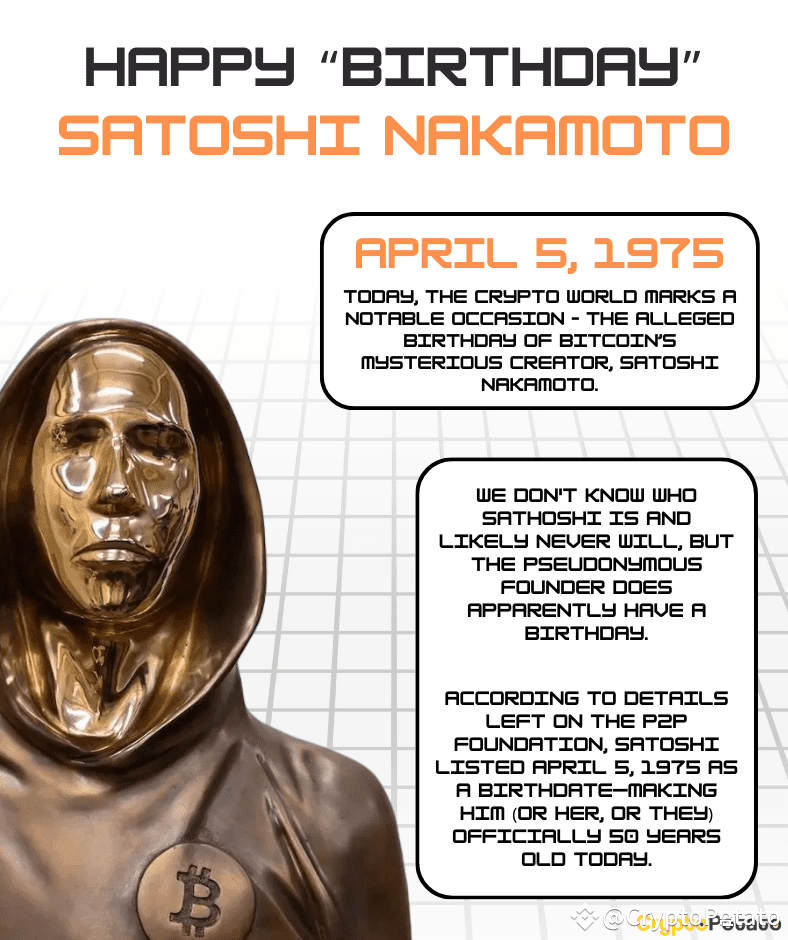
April 5 marks the symbolic birthday of Satoshi Nakamoto — based on the date listed on their old P2P Foundation profile (April 5, 1975).
Whether real or not, the choice is interesting. The mid-70s birthdate would place Satoshi’s “lifetime” across key moments in digital money — from early cryptography research to the 2008 financial crisis that ultimately led to Bitcoin’s creation.
More than a fun detail, it’s a reminder of how one anonymous idea evolved into a global financial movement.
Happy birthday, Satoshi — wherever you are.
📈 Signal
Secondary Markets Are Repricing Crypto Risk
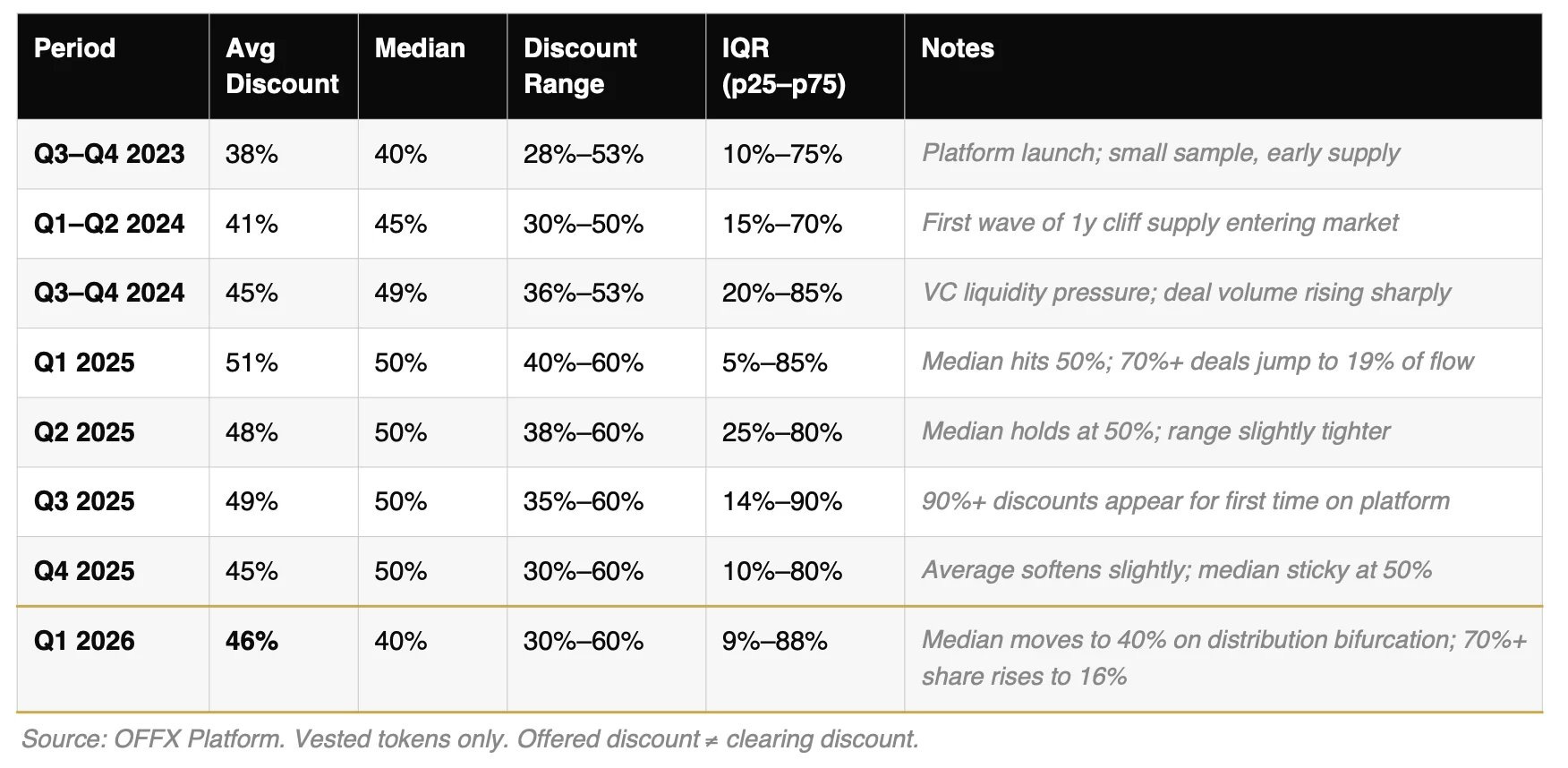
Recent data point to a structural shift in how crypto assets are being valued—particularly in secondary markets.
What’s happening
Tokens are trading at 40–50% discounts on average in secondary markets
Assets with long vesting schedules (3+ years) are clearing at 60–70%+ discounts
Gaming tokens are among the weakest, with discounts approaching 80%
An estimated $500M–$1B in tokens unlock weekly, adding persistent sell pressure
On platforms like SecondLane, ~40% of demand is now for equity, not tokens
Larger deals (>$2M) are increasingly equity-dominated
What’s driving this
This is not a cyclical dip. It reflects a repricing of three risks that were previously underappreciated:
1) Supply overhang is now visible
Unlock schedules that once felt abstract are now a constant source of liquidity pressure. Secondary buyers are pricing this in upfront.
2) Liquidity is selective, not abundant
Capital has rotated toward narratives with clearer near-term payoff (e.g., AI), leaving many token markets structurally underbid.
3) Exit pathways matter more than narratives
Equity offers defined outcomes (M&A, IPO). Tokens, especially with long lockups, rely on future market liquidity—which is no longer taken for granted.
What the market is rewarding
The dispersion is increasing. The assets holding value tend to share three characteristics:
Observable revenue or cash flow linkage
Shorter lockups or immediate liquidity
Active derivatives/hedging markets
What this implies
The market is shifting from narrative-driven pricing to structure-driven pricing.
In practical terms:
Time-to-liquidity is now a primary variable
Token design is being evaluated more like capital structure
Illiquid supply is being discounted more aggressively than before
This is closer to how private markets price risk than how crypto has historically traded.
Bottom line
Secondary markets are acting as a price discovery layer for risks that spot markets often ignore.
The signal is not just that tokens are cheaper.
It’s that the market is becoming more selective about what deserves liquidity at all.
Take action 🚀
If you want to level up your crypto journey, consider subscribing to the premium package.
When you subscribe as a premium member, you also get our report on bitcoin... a $299 value, for free when you subscribe.

And here are some of our latest popular premium posts:
The Solana Yield Engine Powering Borrowing, Leverage, and Liquidity (link)
A Treasury Bigger Than ETH ETFs (link)
AIP Stocks: The Ethereum Powerhouse Wall Street Hasn’t Noticed (link)
Why It Still Makes Sense to Bet on Blockchain Infrastructure (link)
The Long-Term Crypto Investor Playbook (link)
This Crypto Could Make Rollups, Bridges & Sequencers Obsolete (link)
I4 Undervalued Crypto Protocols Generating Real Fees (link)
Wall Street Wants Your ETH (link)
Thanks for reading!
See you next time