

What happens to Bitcoin if AI weakens company moats?
PLUS: Crypto is becoming the highest-revenue-per-employee industry on earth

Hi Investor 👋
welcome to a ✅ free edition ✅ of Altcoin Investing Picks, the most actionable crypto newsletter.
I hope you enjoyed our last issue “20 Million BTC Mined: Why This Is Bullish”
If you haven’t yet, subscribe to get access to these posts, and every post.
In today’s newsletter:
💡 What happens to Bitcoin if AI weakens company moats?
📣 Messari’s CEO is stepping down as the company restructures around AI
📈 Crypto is becoming the highest-revenue-per-employee industry on earth
Let’s dive in!
💡 Insight
What happens to Bitcoin if AI weakens company moats?

Michael Saylor and Chamath Palihapitiya recently debated a big question:
If AI makes it easier to copy products, services, and business models, what happens to capital markets?
It is an important discussion because it could affect how investors think about tech stocks, real assets, and Bitcoin.
Chamath’s view

Chamath’s argument is straightforward:
AI can weaken corporate moats.
If companies lose the advantages that once protected their profits, then investors may stop paying high valuations for them.
In that world, many companies could deserve much lower multiples than the market has given them in the past.
His idea is that capital would then move away from businesses with fragile moats and toward assets that AI cannot easily disrupt.
Examples include:
farmland
hard assets
other forms of real-world collateral
The core point is simple:
If AI makes competitive advantages easier to copy, then scarcity in the physical world may become more valuable.
Saylor’s view

Saylor took the argument in a different direction.
His response was that if AI destroys moats, then investors should look for an asset that does not depend on a moat at all.
That is where he places Bitcoin.
His case is based on three ideas:
Bitcoin has a fixed supply
Bitcoin is neutral
Bitcoin cannot be replicated in the same way a company’s advantage can
So while AI may pressure businesses and compress valuations, Saylor believes it could actually strengthen the case for Bitcoin as digital capital.
In other words:
If the market starts losing confidence in corporate durability, Bitcoin may benefit from that shift.
The quantum computing debate
Chamath added one more challenge.
He said Bitcoin would need to become quantum resistant before it could fully claim to be a reliable store of value.
That is a fair concern in theory.
Saylor’s answer was that quantum computing would not only affect Bitcoin. It would affect the entire digital system, including:
banks
cloud platforms
AI systems
the broader internet
His point was that if quantum computing becomes a real threat, then the whole digital stack would need to upgrade together.
Chamath still pushed back.
His view was that a true store of value must be fully secure. No exceptions.
Our View
The most useful part of this debate is not the drama.
It is the framework.
Chamath is probably right that AI could reduce the value of many corporate moats. That would put pressure on valuations, especially in sectors where products and services become easier to copy.
Saylor may also be right that if this happens, the case for scarce digital assets like Bitcoin gets stronger.
For now, the quantum debate feels less important than the bigger shift taking place:
AI may force investors to rethink what deserves a premium.
That could mean:
lower premiums for companies with weak moats
more attention on scarce assets
a stronger long-term case for Bitcoin.
📣 Update
Messari’s CEO is stepping down as the company restructures around AI

Crypto research firm Messari is going through another major reset. According to The Block, CEO Eric Turner is stepping down, CTO Diran Li will take over, and the company is making layoffs as part of a broader push to become an “AI-first” business focused more heavily on institutional clients, research, and AI-driven products.
This comes after Messari had already cut roughly 15% of staff earlier this year as part of a restructuring aimed at sharpening focus around core product lines.
📈 Signal
Crypto is becoming the highest-revenue-per-employee industry on earth
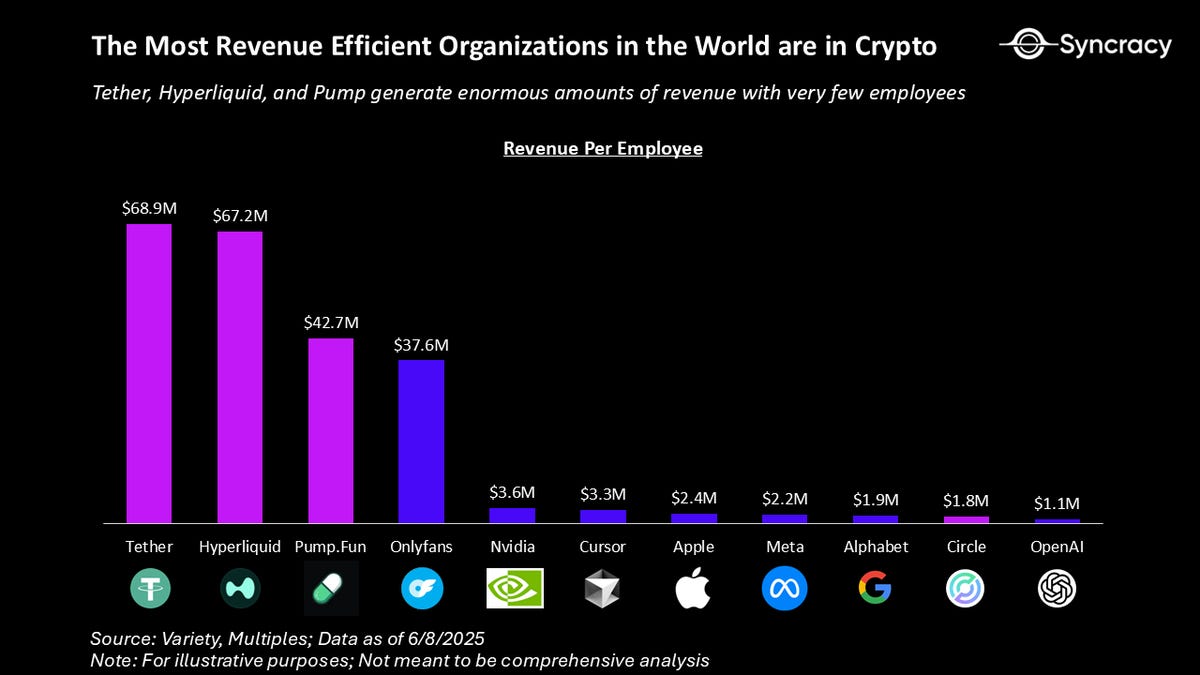
According to Syncracy’s compilation, Tether ($68.9M revenue per employee), Hyperliquid ($67.2M), and Pump.fun ($42.7M) are generating more revenue per employee than nearly every major tech company on the list — including Nvidia, Apple, Meta, Alphabet, Circle, and even OpenAI.
Why this matters
This isn’t just a fun stat.
It’s a signal that the most successful crypto companies are built on:
global distribution from day one
software-heavy margins
token- and incentive-driven growth
small teams with extreme leverage
In other words, crypto isn’t just creating new assets.
It’s creating a new class of ultra-efficient internet businesses.
Take action 🚀
If you want to level up your crypto journey, consider subscribing to the premium package.
When you subscribe as a premium member, you also get our report on bitcoin... a $299 value, for free when you subscribe.

And here are some of our latest popular premium posts:
The Solana Yield Engine Powering Borrowing, Leverage, and Liquidity (link)
A Treasury Bigger Than ETH ETFs (link)
AIP Stocks: The Ethereum Powerhouse Wall Street Hasn’t Noticed (link)
Why It Still Makes Sense to Bet on Blockchain Infrastructure (link)
The Long-Term Crypto Investor Playbook (link)
This Crypto Could Make Rollups, Bridges & Sequencers Obsolete (link)
I4 Undervalued Crypto Protocols Generating Real Fees (link)
Wall Street Wants Your ETH (link)
Thanks for reading!
See you next time